


Singing Across the North Atlantic – by Jo Miller
📷 Photos by ABCassidy Photography
Last month I attended my third North Atlantic Song Convention (NASC) – a formal title for what’s a lively and often informal gathering. The event has been running since 2020 and it’s a weekend packed with singers, songs and discussions about unaccompanied traditional singing. This year’s participants came from Scotland, Ireland, Wales, Isle of Man, Shetland, England, Sweden, Norway, Lithuania, Canada and the United States (Maine). I met a couple of young Scottish singers who hadn’t been before and were revelling in the mix of folk and the chance to listen to and participate in such a variety of singing. The venue, the Scottish Storytelling Centre in Edinburgh, really lends itself to this kind of event: people flow round the building between panel discussions in the auditorium to workshops in the library and singing circles in the large space by the café, sometimes breaking off to have a quiet chat in a corner. There’s a real sense of community as folk interact across the weekend, former connections are renewed and new ones begun.
This year’s keynote talk was given by English singer Angeline Morrison. She spoke of growing up with English folksongs while being aware of her Black identity, giving as an example the powerful ballad ‘The Brown Girl’ (Roud 180, Child 292). This had been a ‘talisman’ for Angeline since she was a teenage folkie, imagining herself as the main character rejected by her lover ‘because I was so brown’. We also heard moving stories of her recent project involving extensive research in archives as she searched for evidence of the history of Black culture in England, and its musical expressions. This resulted in her album The Sorrow Songs: Folk Songs of Black British Experience. Angeline’s talk made me think more deeply about the demands traditional songs make on us, not just as stories but also in the emotional connection they evoke in the singer and the listener.
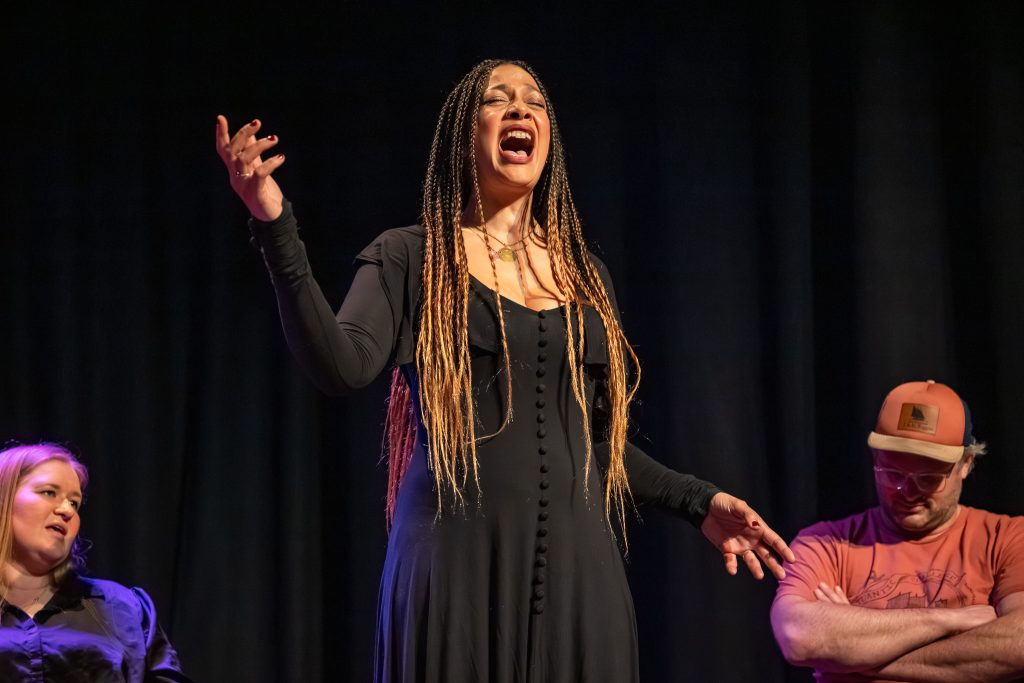
📷 Angeline Morrison (by ABCassidy Photography)
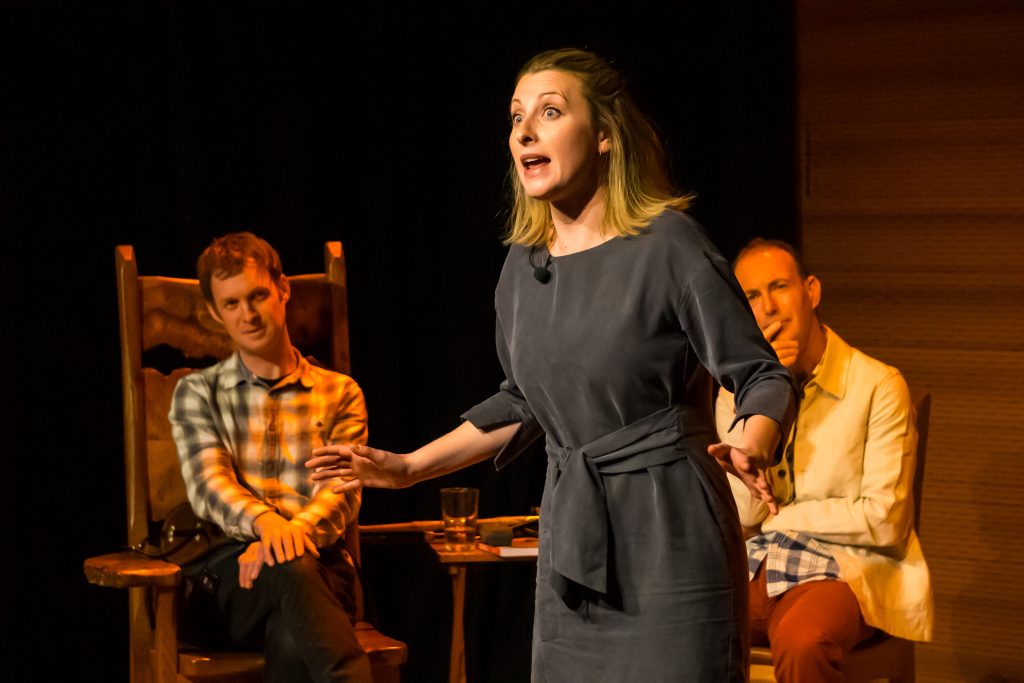
Panel sessions with various themes ran throughout the weekend covering diverse topics such as learning and passing on songs, practical strategies for encouraging participatory singing, and the opportunities offered by UNESCO’s ‘Living Heritage’ Framework in preserving and promoting traditional singing practices. For me, a highlight was the panel on the Irish language sean-nós (‘old style’) solo singing tradition, with Órla Ní Fhinneadha, Ellen de Búrca and Cathal Ó Curráin. All three performed beautiful examples of the repertoire. They also gave us an insight into the learning and teaching of sean-nós, including in schools, the genealogy of transmission, and the competition environment. We learned about the primary role of storytelling in the songs. The intimate nature of the idiom was illustrated by Ellen’s singing from behind a chair as she held on to the back – apparently a common stance for sean-nós singers – as a means of support. The focused nature of the topic and the thoughtful way that the singers shared their experience and contributions from the audience made this a rich session.
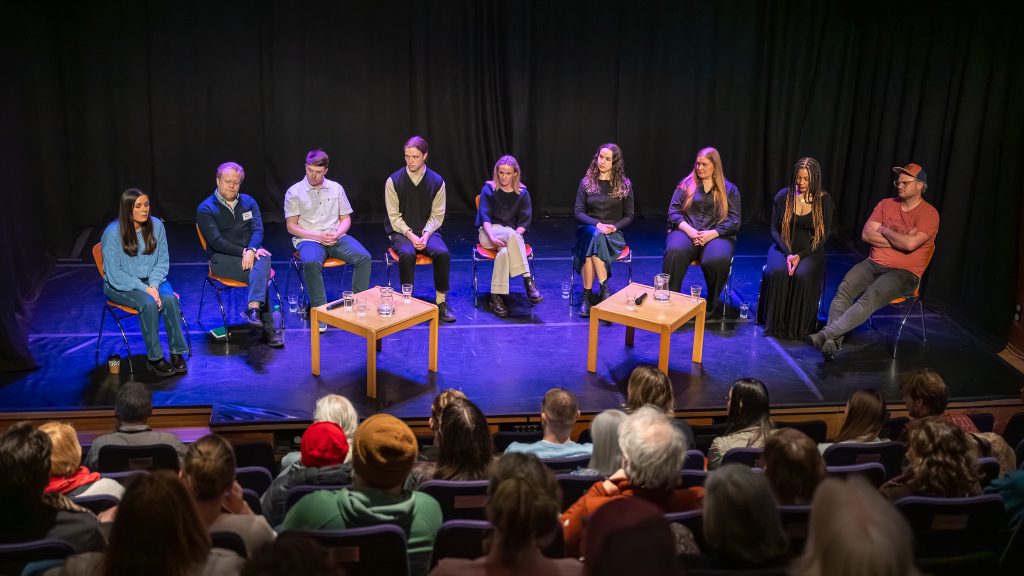
📷 Panel session (by ABCassidy Photography)
There was a menu of workshops including Maine worksongs, Swedish, Norwegian and Scottish Gaelic songs. I joined Steve Byrne’s on Scots song. Making no concessions for a group of participants with a variety of languages and experience, Steve taught 5 songs dense with Scots language: ‘Moss o Burreldale’, ‘Ballad of the Speaking Heart’, ‘Brisk Young Lad’, ‘We’re aa Noddin’ and ‘Hey ca’ thro’. We all jumped in and learned, I suppose, by immersion! I love singing in Scots – and in songs like these tunes and lyrics feel tightly fused and really rewarding to sing. The item I knew of but had not sung before was the humorous ‘We’re aa Noddin’. Steve gave us the version which came via Robert Burns, pointing out the theme (drunkenness) and the dangers of the chorus in becoming a likely ‘earworm’. When I came home, I did some research and went down some interesting rabbit holes! The ‘nodding song’ seems to have had extraordinary success during the 18th-19th century in many versions including beyond Scotland, the rhythmic repetitive chorus lending itself to parodies of all sorts. ‘We’re all nodding’ even became the title of a lithograph of 1861 depicting a sleepy soldiers on horseback. It’s a reminder of how traditional songs can be a rewarding portal through which to explore the past, and how malleable they can be as they’re adapted for different contexts.
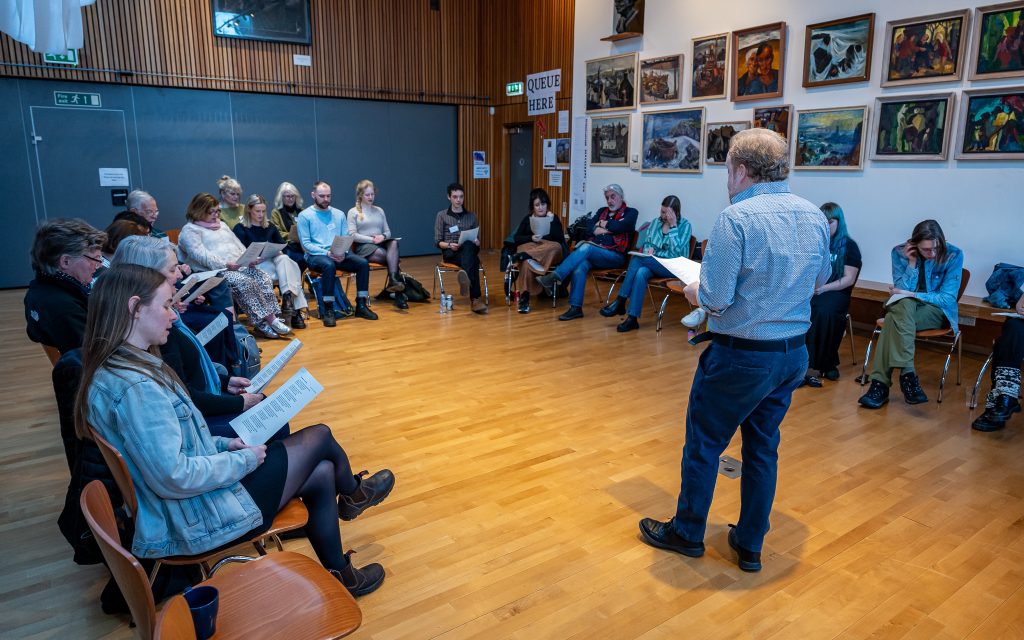
📷 Workshop with Steve Byrne (by ABCassidy Photography)
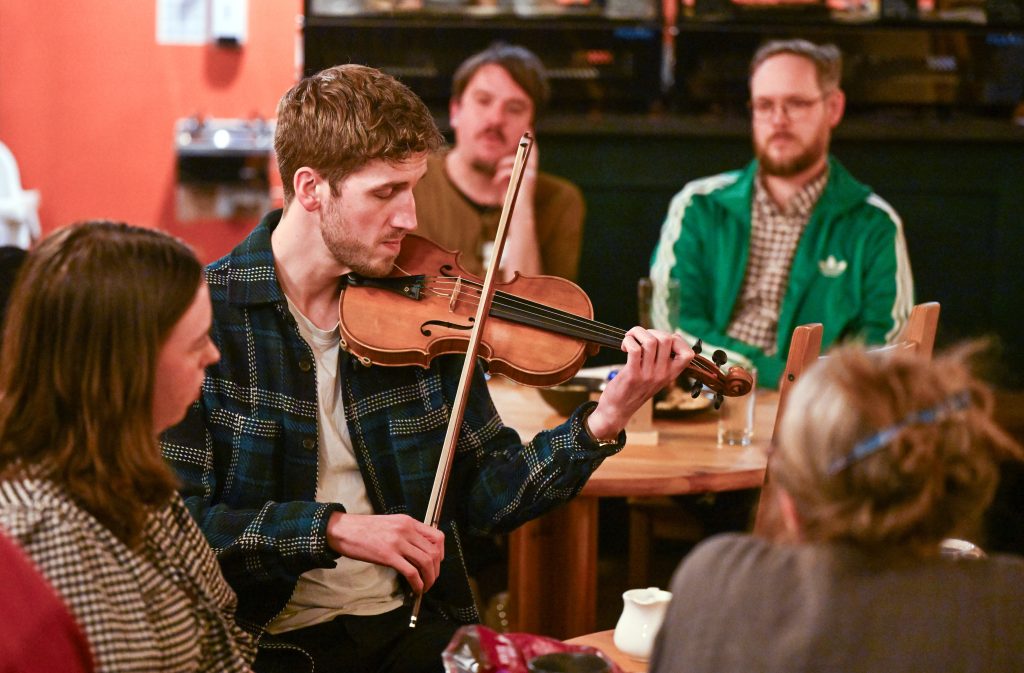
While larger singing sessions were also going on, at the intimate song circle I went to there was encouragement but no pressure to sing, and no ‘policing’ of song choices. This was a good opportunity for younger participants, including some Swedish students unused to singing in public, to try out their voices and their songs. I used it as a chance to sing a couple of songs I’d not done in a while to see if I could remember the words. I was reminded that the song circle format is a rich resource not only for ‘performance’ but also learning, practising and sharing stories in a supportive setting. And not least that listening is as important as singing.
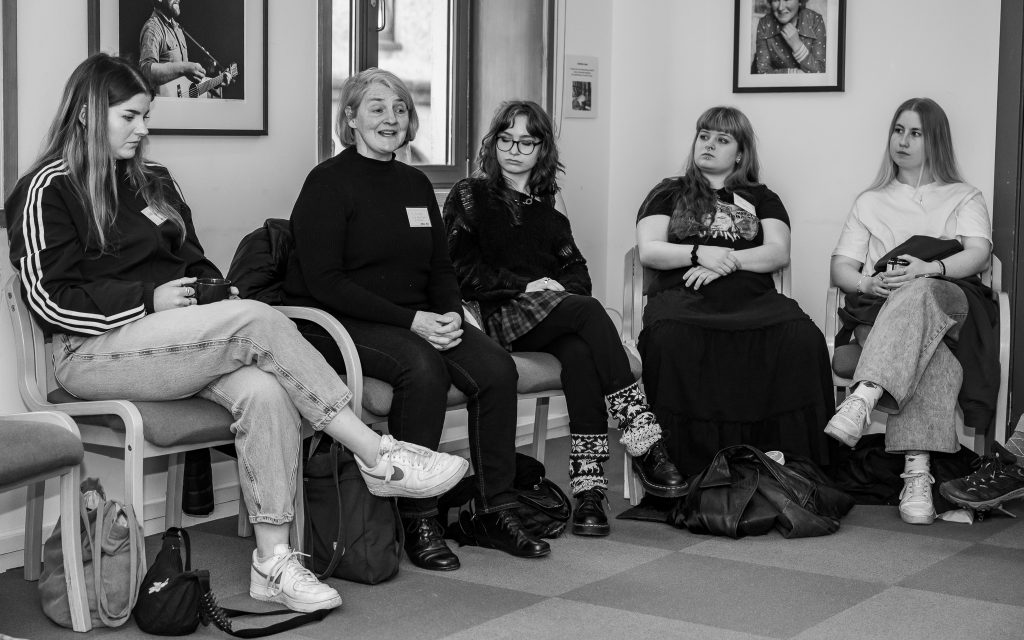
📷 Singers at a small song circle (by ABCassidy Photography)
I couldn’t make the Friday evening pub session but heard next day that it had been a great night. One of the highlights was an hour-long impromptu flow of mouth-music (puirt-à-beul) and dancing songs from different singing cultures, which Brian Ó hEadhra dubbed a ‘puirt-off’. I wouldn’t be surprised if it is reprised next year! A Saturday night concert offered guests an opportunity for a more formal presentation of their songs, but this, too, demonstrated the collective ethos of the weekend, with participation across the performances and including the audience.
I came away reflecting once more on the lives of songs and their power to bring the past into the present and connect us across cultures. In June I’m heading to Aberdeen to take part in NASC’s big sister, the North Atlantic Fiddle Convention, to play, learn and talk about tunes and dancing. The format of both festivals is a rich mix of activities and opportunities to experience the traditional music of our North Atlantic neighbours and form musical friendships between these countries. Meeting and sharing music face-to-face in this way highlights contrasts and commonalities which only deepen our understanding of the factors that shape and sustain traditions. NASC is now run in partnership with the Traditional Music Forum of Scotland, and I found myself thinking of what it takes to organise events like this, and the crucial part played by organisations and institutions in – literally – keeping the show on the road. There’s an inclusivity and a democratic ethos to NASC which bodes well for its own longevity, and which I’m sure is the key to our individual and collective efforts to cultivating our traditional arts well into the future.
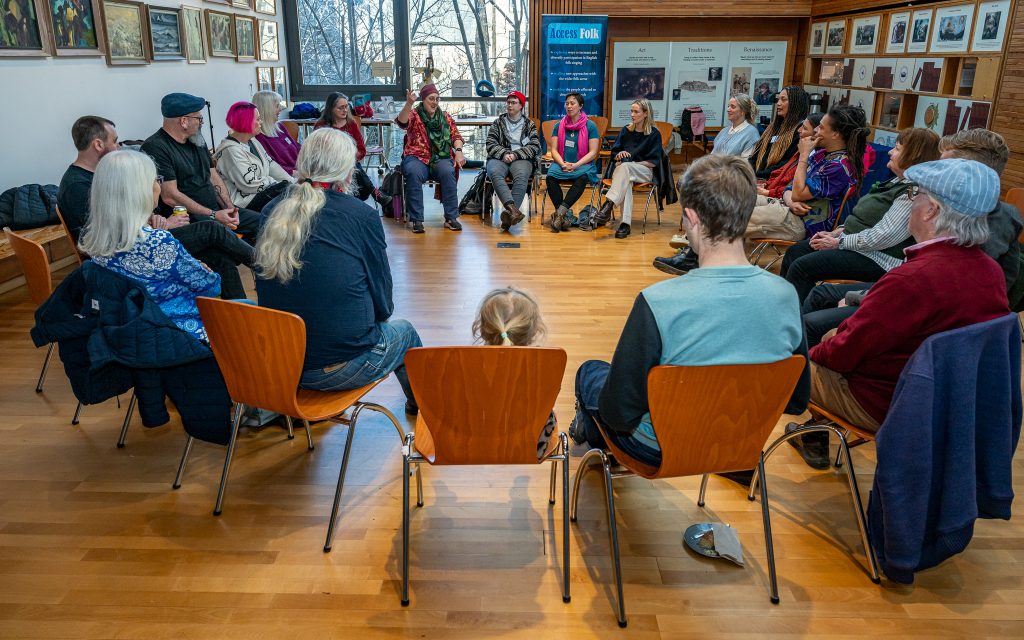
📷 Song circle (by ABCassidy Photography)


