Highland dance is a solo dance tradition most closely associated with Scotland’s Highland Games. Today it is performed in competitions across the country and internationally, combining precise technique, strength and musicality.
During the 20th century, Highland dance became regulated, with organisations established to standardise teaching, examinations and competition judging. The principal bodies are the Scottish Official Highland Dance Association and the Royal Scottish Official Board of Highland Dancing. Regulation brought consistency to teaching and assessment, but Highland dance remains part of Scotland’s wider living dance tradition.
Until the 20th century, dance teachers in Scotland were often known as dancing masters. Many were itinerant, travelling from town to town and teaching for several weeks at a time. They taught Highland dances alongside Scottish country dances and other fashionable forms. Although teachers shared repertoire, there were often significant local variations in steps and style.
One of the earliest detailed written sources for Highland dance steps comes from Francis Peacock, an Aberdeen dancing master who began teaching in 1747. In his 1805 book Sketches, Peacock described steps he had observed Gaelic-speaking Highlanders perform in Aberdeen and Speyside. He noted that steps could be combined or altered freely, provided they fitted closely to the music and satisfied the dancer — advice that still resonates in traditional dance practice today.
There is no clear evidence of the Highland Fling before the late 18th century, and the Sword Dance appears to date from the early 19th century, although sword dances are found in other parts of Europe. The Sean Triubhas, meaning “old trousers” in Gaelic, is thought to interpret earlier percussive dance styles of the 19th century.
The Core Repertoire
There are five principal dances in today’s competitive Highland dance repertoire:
Each dance has a recognised structure and specific steps, performed in a set order in competition settings.
Music and Performance Style
Highland dances are performed to strathspeys and reels played on the bagpipes. At outdoor Highland Games, dancers are usually accompanied by a live piper, while indoor competitions typically use recorded bagpipe music.
Although the music is not particularly fast, modern competition speeds are often slower than in previous decades. This allows dancers to demonstrate elevation, precision and control. The contemporary competitive style is athletic and technically demanding. Dancers aim for strong turnout, extended pointed feet, high jumps and controlled landings. Arms are held in stylised positions, with raised hands and grouped fingers traditionally said to represent a stag’s antlers.
Compared to earlier forms, today’s Highland dancing emphasises height, stamina and gymnastic clarity of line, reflecting the evolution of competitive standards over the past century.
Regulation and Examinations
By the mid-20th century, the wide variety of steps and regional styles made judging competitions increasingly difficult. In response, regulatory organisations were established in 1947 and 1950 to standardise technique, repertoire and competition rules.
Highland dancers typically begin training in childhood and progress through graded examinations. Teachers must also complete a series of professional examinations in order to become licensed to teach. This structured system ensures consistency in teaching and assessment across Scotland and internationally.
Learning and Participation
Highland dance is performed throughout Scotland and far beyond. Competitions take place at Highland Games between May and September, as well as at indoor events during the rest of the year.
The Royal Scottish Highland Games Association publishes an annual calendar of Highland Games events. Dance schools operate across the country, with licensed teachers providing structured training for children and adults.
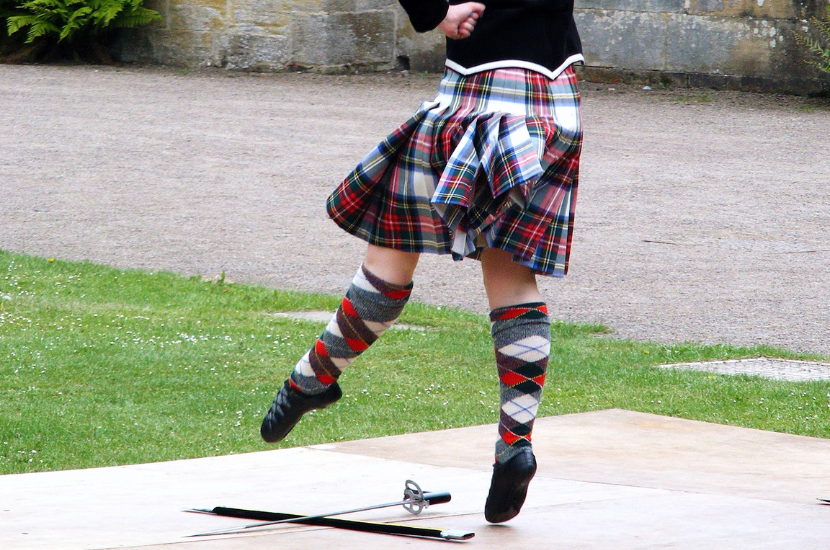
Highland dance continues to evolve while maintaining strong links to its historical roots. It remains a highly visible part of Scotland’s cultural life, combining tradition, discipline and performance. As both a competitive art form and a living heritage practice, Highland dance plays an important role within Scotland’s wider traditional arts landscape.
More information and lists of Highland dance schools can be found on these websites:
TRACS (Traditional Arts and Culture Scotland, SCIO SC043009) is a co-operative network which champions our shared traditions of music, song, storytelling, dance, crafts, customs and indigenous languages. Together we celebrate the local distinctiveness of Scotland’s places: our intangible cultural heritage. Registered office at the Scottish Storytelling Centre, 43-45 High Street, Edinburgh EH1 1SR.