


Secret marriages, hand-crafted love notes, and carefully chosen tokens of affection – six hundred years ago, these were the kinds of Valentine’s Day customs one might have been privy to.
Emerging from a weaving of Roman, pagan and Christian traditions, Valentine’s Day has shifted and been reshaped over centuries, with many Scottish customs long held and observed.
Today, though heavily commercialised, the heart of the day remains: an offering of love, intention and generosity.
Here, we share some of these traditions, alongside Scottish tales of love, romance and how it compares to the 14th of February we know today.
Traditions & Customs
Imagine this. Instead of swiping right on someone you fancy, you wake up on the 14th of February and the first unmarried man/woman you encounter becomes your Valentine. This is just one of the many traditional, more superstitious Scottish customs that used to be about, and would play a part in aligning you with a (potential) match.
A similar custom was that of name-drawing – this meant that young unwed men and women wrote their name on a bit of paper, placed them in a hat and each drew one of them out. If one name was read out three times, it meant a marriage was on the cards.
As you can see, there is a bit of a pattern here – leaving your love-life up to luck, destiny and the fate of the universe. Not to mention your local community’s involvement in affairs of the heart.
Along with these rituals, there were some more meaningful traditional tokens of affection that are embraced around Valentine’s day. Some examples included,
- Luckenbooth Brooches
- Often worn by Scottish women for protection from harm and evil spirits, these were commonly given as a gift from a mother to her daughter. But also, the Luckenbooth would be gifted from a man to his love as a token of protection and loyalty.
- Scottish Love Quaich
- Dating back centuries to the Highland clans, this small, shallow bowl symbolised unity and trust. It featured prominently in Scottish ceremonies, celebrations and commemorations, and continues to hold significance today, often used in wedding celebrations when couples tie the knot.
Ballads of Love & Longing
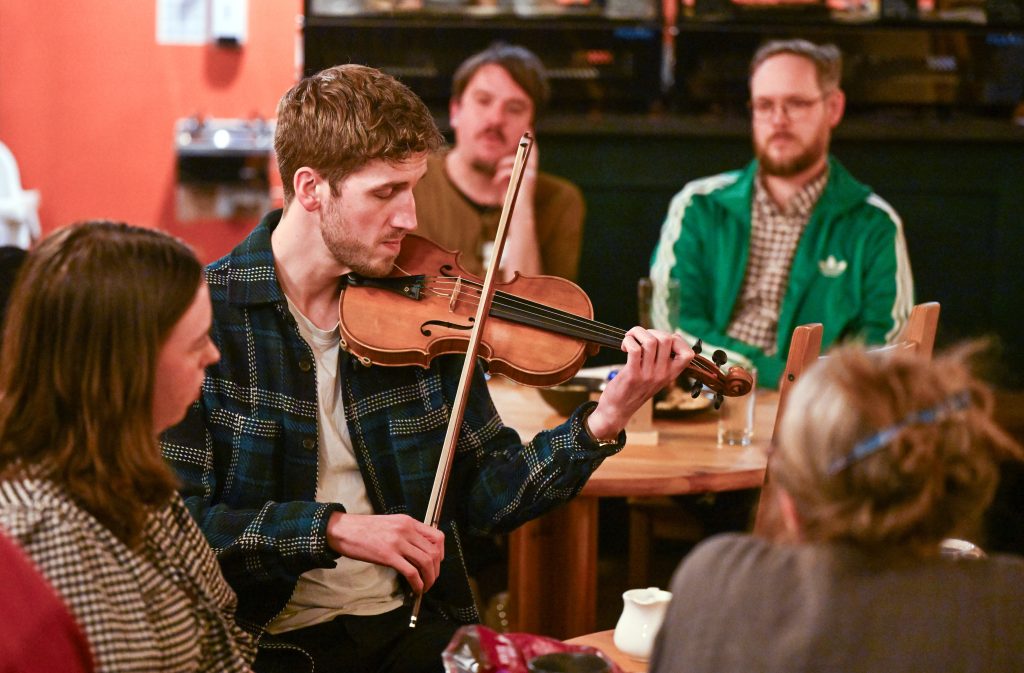
Beyond brooches, love in Scotland has long been carried on through song. For centuries, folk ballads told stories of devotion, heartbreak, reunion and longing often inspired by real people and real places.
Songs such as “Annie Laurie” spoke of unwavering admiration, while “Ae Fond Kiss”, by Robert Burns in 1791, captured the sorrow of parting lovers with tenderness and peace. In the Highlands and Islands, Gaelic songs like “Mo Rùn Geal Òg” expressed deep affection and aching separation, their melodies passed from voice to voice across generations.
These songs were not simply entertainment; they were declarations. In times when distance kept lovers apart, music became a way to preserve feeling. Sung by firesides, at ceilidhs, they kept the romance alive.
In Reflection
Though the way we celebrate Valentine’s Day has changed – from superstitions and thoughtful tokens, to online messages, teddy bears and wrapped bouquets – the essence remains familiar. Whether drawn from a hat, discovered by chance on a February morning, or chosen with careful thought, love has always been about intention.
Perhaps that is what connects us most to those who came before us. Six hundred years on, while the rituals may differ, the desire to express affection, loyalty and hope endures.


