


I have been fascinated by bagpipes for as long as I can remember. It began, I’m told, when, as a three-year-old boy growing up in the Perthshire town of Pitlochry, I used to demand to be taken down to the main street every week in the summer months to watch the local pipe band, the Vale of Atholl, march through the town to entertain locals and tourists alike. I can’t recall whether it was the sight, the sound, or (more likely) the combination that stirred something within me, but whatever it was, from then on I was hooked! When I was six years old, my mother saw an advert in the local newsagent’s window advertising free lessons being given by the band, and asked if I wanted to try it. I certainly did! The teacher was Allan ‘Piper’ Cameron, at the time recently retired as pipe major of the Vale of Atholl, but who had agreed to stay on to help teach the next generation coming through.
First Lessons with Allan ‘Piper’ Cameron
I very well remember that in my first lesson, my pinkie finger couldn’t quite reach the bottom hole of the practice chanter. Allan suggested that I take the chanter home anyway, and see how I got on. If I still couldn’t reach by the following week, then we’d leave it for a year and then try again. I spent the week stretching that finger like nobody’s business! Come the following Wednesday, all was well, and my piping career began! By the age of eight I was ready to move up from the practice chanter to the full bagpipes, and the following year I joined the band. It was the beginning of a wonderful journey of music and friendship, as the band, full of young players like myself, began to climb up through the competition grades and within a decade we were crowned both Scottish and European champions and were ranked within the top three pipe bands in the world. We toured throughout Europe, Canada, the USA and we even had a trip to Indonesia. They were great times and we made wonderful memories.
A Lost Tradition
All of this, however, involved the Great Highland Bagpipe – the loud, strident three-droned instrument which for several hundred years had become synonymous with Scotland. That was hardly surprising, as this was the only form of Scottish bagpipe that existed at the time. It hadn’t always been that way: smaller and quieter forms of the instrument, such as smallpipes, Border or Lowland pipes and reelpipes, all driven by bellows rather than by human lungs, had been part of the musical landscape for several centuries in the past, but had gone out of fashion and had become virtually extinct by the early twentieth century. There may have been some sets lurking under beds and tucked away in lofts, but even the few that had found their way into museums were usually mis-labelled as either uillean pipes from Ireland or Northumbrian pipes from the north of England. But in fact, they were neither: they were actually the last surviving remnants of a lost tradition.
The Revival Begins
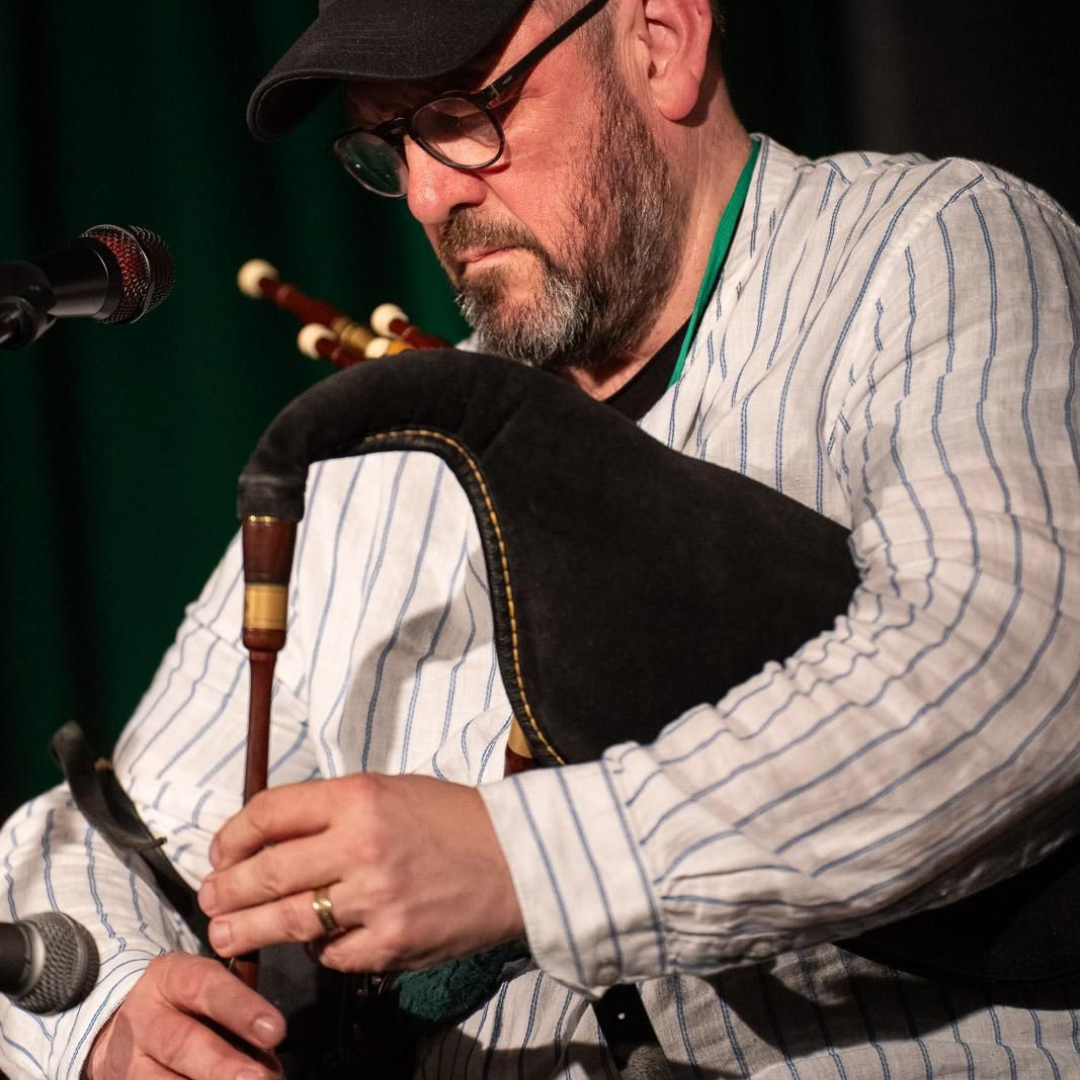
The early 1980s saw the beginnings of a revival of these smaller, bellows-blown bagpipes here in Scotland, and the resurgence of interest in them has been immense in the intervening years. I got my first set soon after the revival began, and I’m lucky enough to spend a lot of my time now teaching these across Scotland, in Europe and in many parts of the USA. They are gaining in popularity all the time and there can be no doubt that the revival has been a major success, and these bellows pipes have taken their place once again in the carrying stream of living heritage.
The pitch and relatively low volume of Scottish bellows pipes make them more suitable for playing with other instruments than their louder Highland cousins, and so they have been enthusiastically welcomed into the wider traditional music scene both here in Scotland and well beyond. The fingering style is compatible with that of the highland pipes, although a few subtle adjustments to technique can certainly help to get the best out of these instruments. Because this was a severed tradition, a good deal of the detail regarding how they might have been played before their disappearance has been lost, and our knowledge and understanding of exactly how techniques, style, tempos and repertoire were transmitted between generations is scanty to say the least. That can be refreshing, however, as it means there are no rules that must be obeyed!
It is wonderful to see so many young people taking up the Scottish bellows pipes, and to witness them taking the instrument in various musical directions. Teaching and transmission is alive and well once again, with an emphasis on both ear-learning and use of written scores. There is a healthy corpus of new compositions emerging, while older manuscripts and collections are not being forgotten by any means. They are being performed in pub sessions, in folk bands, in dance halls and on major concert stages, their versatility allowing them to add positively to many musical genres.
In short, the bellows bagpipe tradition of Scotland is no longer reviving, but rather it has revived. It is an active, thriving, living tradition once more, and in my view, it is now here to stay!
Living Heritage Update: The Scottish Piping Centre has recently submitted ‘Scottish Bagpiping’ to the UNESCO UK Living Heritage list in the ‘Performing Arts’ category of Scotland’s Living Heritage. To see what’s been submitted, you can visit livingheritage.unesco.org.uk
Written by Gary West.


