


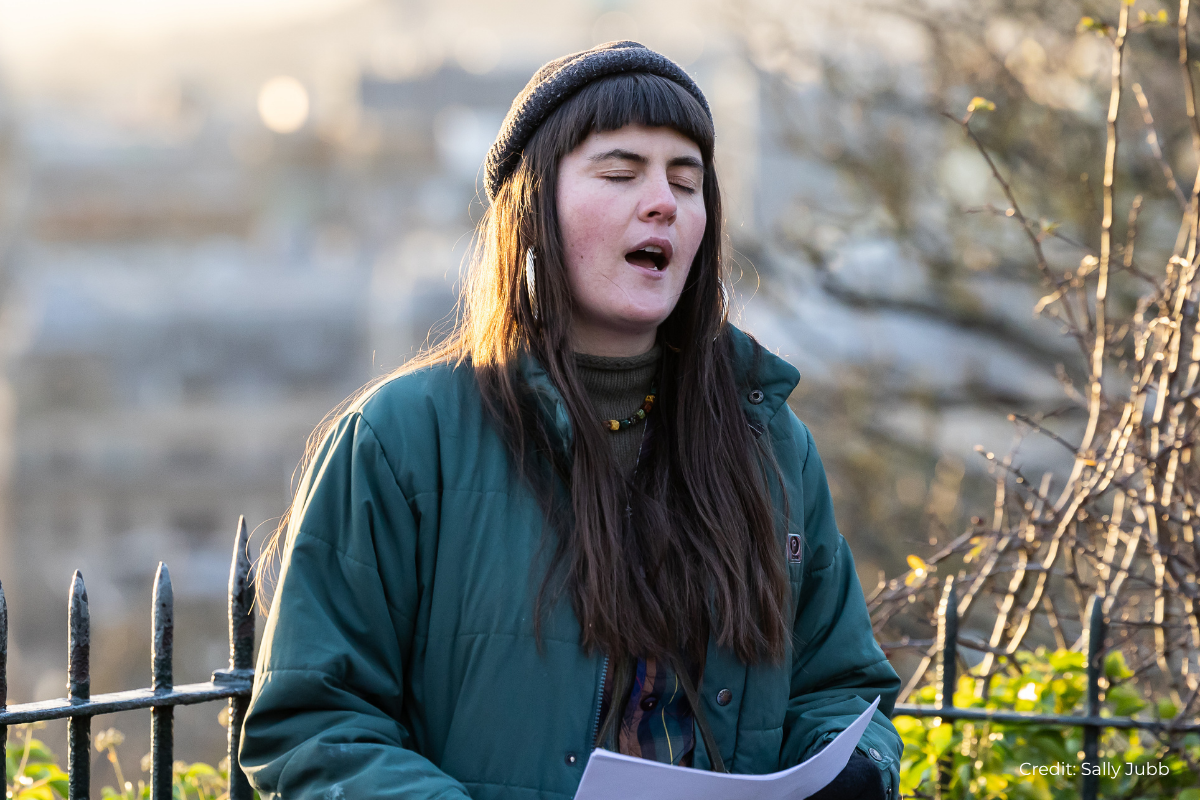
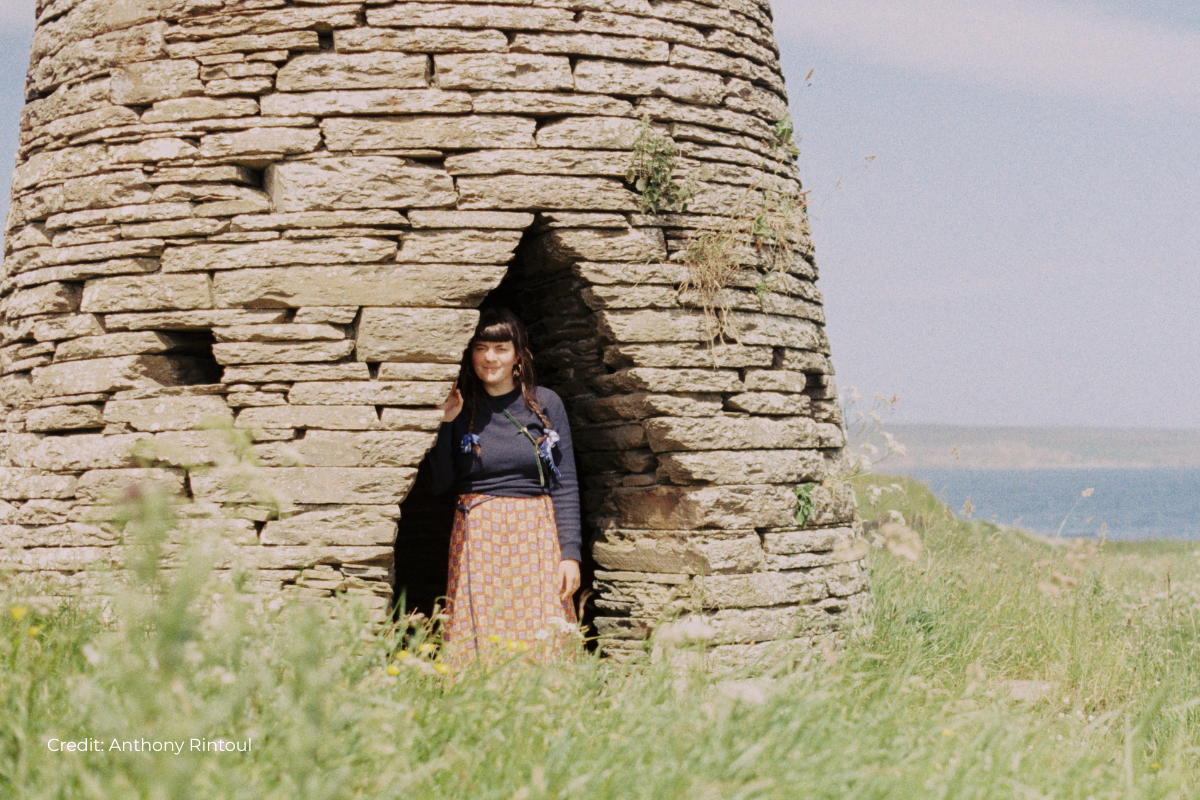
Performer and artist, Josie (Quinie) explores landscape, tradition, folklore and identity through song, writing and visual art. Drawing inspiration from Scots song traditions, archival material and the singers who came before her, she reworks and reimagines traditional music through a deeply personal and contemporary lens.
In our latest blog, learn more about Josie’s creative practice and how she contributes to Scotland’s living heritage through music, storytelling and art.
How it Started
I don’t come from a traditional music family, and I didn’t have any formal music training apart from a guitar group at school. My parents were told at parents’ night that I wasn’t a serious enough student because I wanted to be a ‘pop star’. Aka play Tracy Chapman and David Grey covers. Most of my musical education came from singing at school and then playing music with friends around campfires while camping.
Like lots of us who went to primary school in Scotland, I remember sitting cross-legged in assembly singing my heart out to the Jeely Piece song. I don’t know if it was a particular teacher at my school, or a more general Scots upsurgance in schools in the nineties, but I was lucky to get exposed to all the classics – Three Craws, Coulters Candy, The Welly Sang, The Bonnie Banks. From a really young age, I loved these songs and the Scots language in them.
As a teenager my repertoire extended to some cheesy Scottish classics (think Caledonia, Wild Mountain Thyme), onto some Burns songs. I liked to play the odd open mic night, some indie songs on guitar, and picked up a banjo and learned some Americana-type stuff, but never considered performing or ‘being a musician’. Eventually, I heard the Scottish Traveller singers, particularly singers like Lizzie Higgins and Sheila Stewart, and their voices and repertoire shaped what I went on to do as Quinie.
Why Traditional Song?
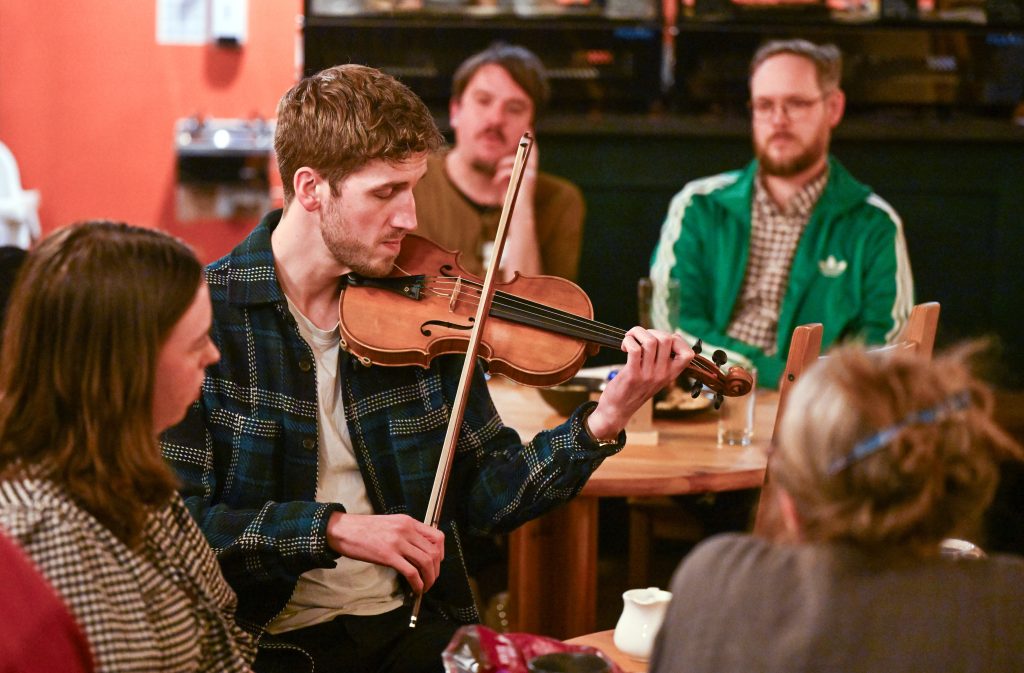
I have always loved traditional music, and there is nothing that stirs my blood like a good pub session with some excellent musicians, but I have always seen myself as an appreciative outsider.
The thing I like about traditional song first and foremost is that it feels like it’s for the taking. It’s something that we are all invited to learn, perform and play with. I think this makes it quite different from performing cover songs or replicating other people’s work. For me, the joy of the singing came first so I was drawn to be able to just pick things up and sing them without having to do any composition first.
The other thing about traditional song is that it really reflects my sense of identity and my relationship with place. I like the descriptions of landscape, weather, labour and ordinary life. They contain ways of speaking and melody that feel familiar to me. Scots language itself carries a lot of that texture.
Finally, traditional music is endlessly variable, so I will never get bored. Songs change constantly. Different singers shape melodies differently, forget verses, combine fragments together, or adapt songs to fit their own interests and lives. That continual shift keeps the music alive for me. I never feel as though I could run out of things to expand on.
The Creative Process: How Do You Begin Writing New Music Inspired by Traditional Song?
I often know immediately; If I like a song well enough to learn it. It may be that I really love the melody and I’m less fussed about the lyrics; in that case, I tend to take the melody and match it to poetry. I love the poetry of Marion Angus, and I often work with her stuff. I will put it to tunes from other songs, or melodies from pipe tunes, for example.
I would say I usually am collaging material together, rather than composing from scratch. It’s very unusual that I would start with nothing and just summon something from my mind. I suppose even if we are summoning something from our minds, we are probably drawing from influence somewhere, even if it’s subconscious. I think it was David Bowie who said something like “The only art I’ll ever study is stuff that I can steal from”. The trick for me is to have a really broad pool of influence to draw from – Scottish traditional song, someone playing free jazz drumkit with an acorn, a tree I like, all the worlds in my bookshelf. There’s so much in the world to distil into songs!
I like to know the roots of my songs, and I always read about where they’ve come from and who has sung them over time. I make sure they align with my values, and then I tend to promptly forget the details. I’ve got comfortable with the role of forgetting things in the transmission of Scots song and traditional song more generally. I think sometimes we forget the things that are least relevant to us, and that keeps the tradition moving.
Challenges Working with Archival Material
In terms of working with archival material, I think one of the challenges is that you want to reference your sources, but you also want to recognise that these archives are just a product of a moment in time, and that singers are always transmitting songs from one another in an organic way. I think another problem with archives is that if we rely on them too heavily, we are all drawing from the same pool of songs, and we forget that we can create new ones.
I also have a slight aversion to the use of archival sampling in songs, I don’t know why, but for me it just doesn’t do it for me. I would never sample an archive for recording in my work. And I don’t allow other people to sample my singing either. It is often a shame when I’m asked, because I like people’s work and love collaborating, but I just have a thing in me that has decided it’s not a good idea
How Do Your Creative Projects Overlap and Inspire One Another?
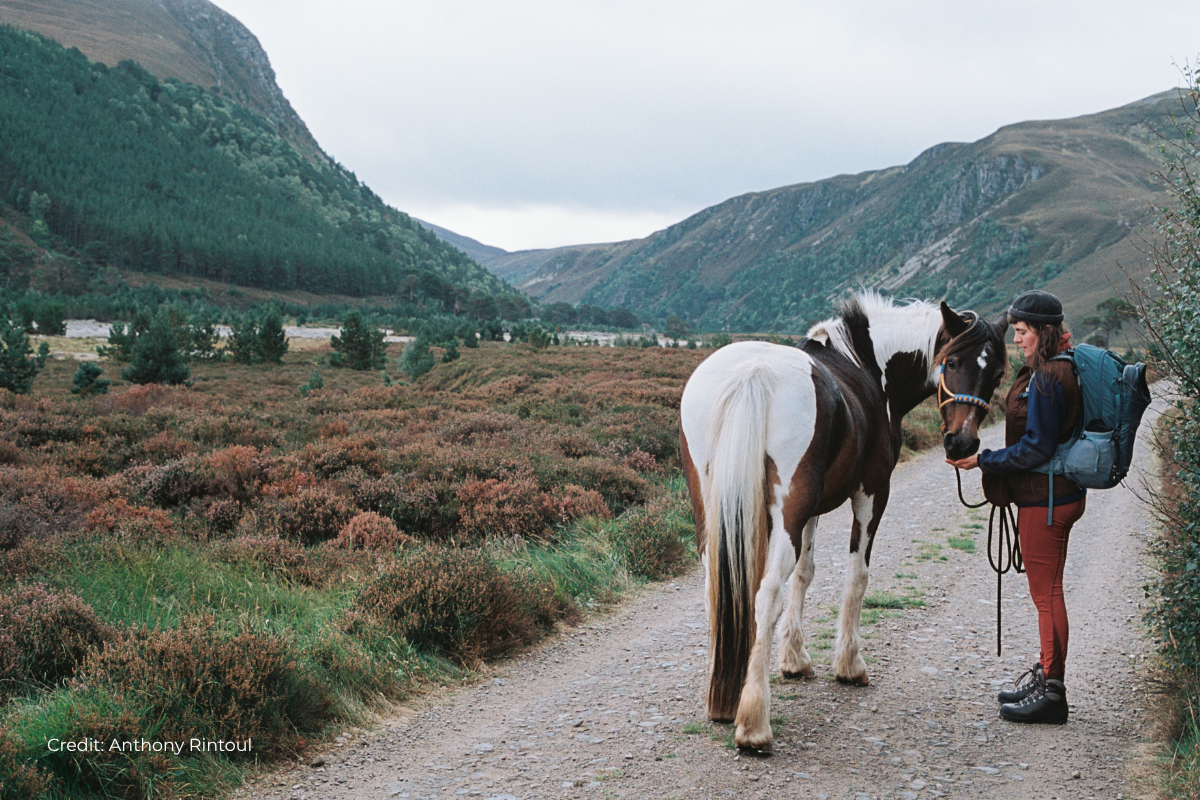
I would describe myself as a highly monotropic person. That means that I have a very strong, focused attention. What I do is I pull in all of my interests through my songs. And I link my songs with all of my other interests. It sounds a bit confusing, but what it means is that to me, everything is intricately linked. Even though from the outside it may seem that horses, songs, learning how to make pots, pigeons and designing complex systems are all quite disparate things. To me, they are all an investigation into how we can simplify the experience of being Human and understand our environment. So it all makes perfect sense to me.
How Do You Share Tradition-Inspired Work and Connect Through Storytelling?
I’ve always been drawn to share work. I like writing about, sharing visually and singing. I do like performing, but I also find it draining. Initially, I used to go to a lot more community singing situations. Things like the traditional music festivals. I struggle with my interest-focused nervous system. If I don’t like whatever I’m hearing, or it’s not speaking to me directly, I find it very stressful to try and make myself sit still for any length of time. So I have found over time that I prefer to do solo research and be quite directive with the musicians I’m working with, so I know that I’m going to be making something that sparks me.
My favourite way to share my work is to be able to talk and sing, explaining in detail why I sing certain things. I also wrote a book, which was released with my previous record, and I really loved putting that together. I found that I was able to express exactly what I wanted by writing and working with a fantastic graphic designer, Dominique Rivard. I also really enjoy putting the music videos together because it helps me create little worlds that the music sits in, and I like communicating those to people.
There are so many different ways to communicate the messages I want to embed in the music. Obviously, it helps that actually releasing a record means it reaches lots of people. So I was really lucky to be offered the opportunity to release with Upset The Rhythm, mainly because they are very supportive, but also because they have a wide reach to people I respect. Without them, I don’t think an album of Scots song would have been The Guardian’s Best Folk Album of the Year! I would have been heard by far fewer people.
What’s Next?
I’m currently putting together quite an ambitious project plan that would involve exploring a kind of regenerative system of archiving. It’s in its early days, but I am excited to have so many interesting artists on board and support from various partners. I don’t want to jump straight back into making another record, and I did find touring, even though it was only a small amount, quite hard to balance with all my animals and work, etc. So I’m giving myself a break from performing at the moment to let myself think about new ideas.
What Advice Would You Give to Artists Creating Work Inspired by Traditional Song?
My advice to others would be to reject the idea of gatekeepers to the tradition. Maintain respect for people who have sung before you, learn from sources in a way that suits you, and don’t let anyone tell you that they own songs.
The most important thing is it’s meant to be fun, and I also would say I’ve always had other work to support me, and I have never tried to make music my job. That keeps it alive for me and suits me.
Don’t wait around for validation. I decided to release my own initial albums, and then I had some friends who helped me put them out on tape. Starting small like this gave me loads of room to explore my ideas at my own pace and meant that my practise developed really organically. If you are experimenting on a small scale, then failure doesn’t exist, its all just learning. I wouldn’t have done it any other way, and I don’t think I would have been so successful with my most recent record if I hadn’t had those foundations of 10 years of DIY practise behind me.
Don’t wait for things to be perfect, just get them out into the world. You can always revisit things. See your music as a communication of who you are- uniquely. So don’t go browsing other people’s press shots and try to recreate the perfect glam on a beach trad headshot. Invite the photographer into your real life. Use a nice photo your friend took of you barbecuing a sausage. Find ways to reveal these parts of yourself that you are desperate for people to see. That’s what makes it rewarding and world-building.
Find Josie
Website: www.quinie.co.uk
Instagram: @quinie.music
YouTube: youtube.com/@quiniemusic
Bandcamp: quinie.bandcamp.com/
Research film: Forefowk, Mind me


