



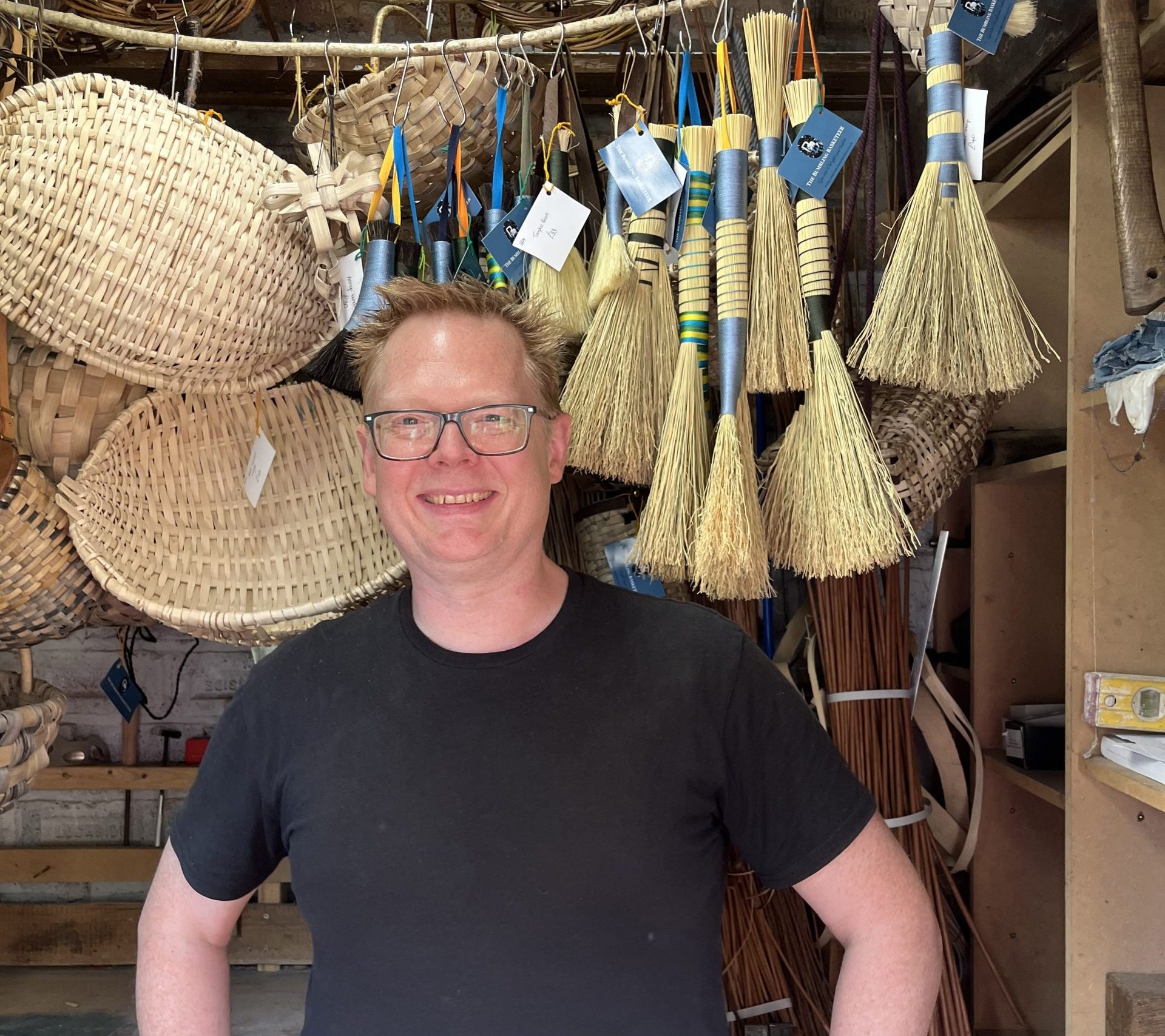
Hear from Simon Cooper as he talks about his journey into becoming a basketeer. What started as a moment of curiosity turned into a passion for traditional crafts. In this blog, Simon opens up about swapping stress for split oak, stumbling into brush making at a festival, and the wonderfully generous community of makers he’s met along the way. It’s a story of curiosity, craftsmanship, and community – and a reminder why it matters that these skills don’t disappear.
Where it started
My route into traditional craft was perhaps a mixture of curiosity, necessity and a fair amount of serendipity.
I work as a GP in Perthshire and have always enjoyed making things. Woodworking, furniture making and drawing have all been hobbies over the years, but I first became fascinated by oak swill basketry after watching Owen Jones making a basket on the television programme Victorian Farm. I have always loved oak as both a timber and a tree, and there was something magical about seeing a basket emerge from the split oak, which was then strong enough to stand on.
Following the pandemic, and after a difficult period with work-related stress, I started looking for something different. My first thought was to learn directly from Owen, but by then he was no longer teaching regular swill basket courses. Through sheer luck, I discovered Lorna Singleton’s year-long Wood Water Weave programme. Lorna had herself learned swill basketry from Owen, and the course promised ten monthly instalments of learning different split-wood basket traditions.
I immediately applied, then promptly panicked because I had never made a basket in my life.
Before the course began, I made my first willow basket and thoroughly enjoyed it. The Wood Water Weave course exceeded all expectations. It wasn’t simply about basket making. It connected woodland management, seasonal cycles, traditional skills and community in a way I had never experienced before.
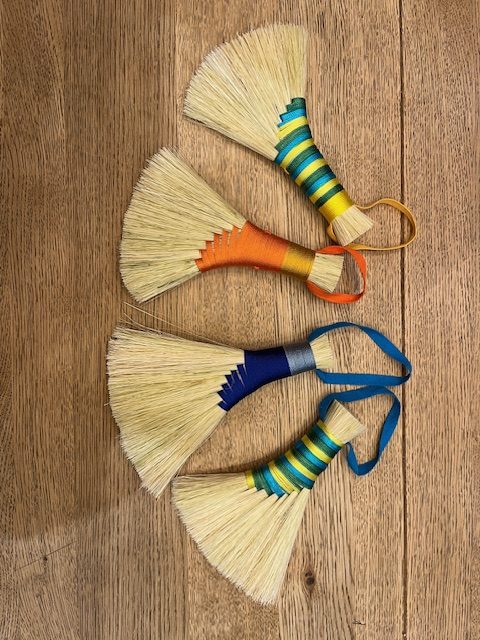
Brush making entered my life in a similar way. While helping Lorna at a festival, I noticed a brush-making workshop being run by Rosa Haradine. I signed up out of curiosity and immediately fell in love with the craft. Since then, I have continued to develop both brush-making and basketry, working from my own workshop in Perthshire.
Roots and Tradition
Heritage and place are deeply important to my work, particularly in oak swill basketry.
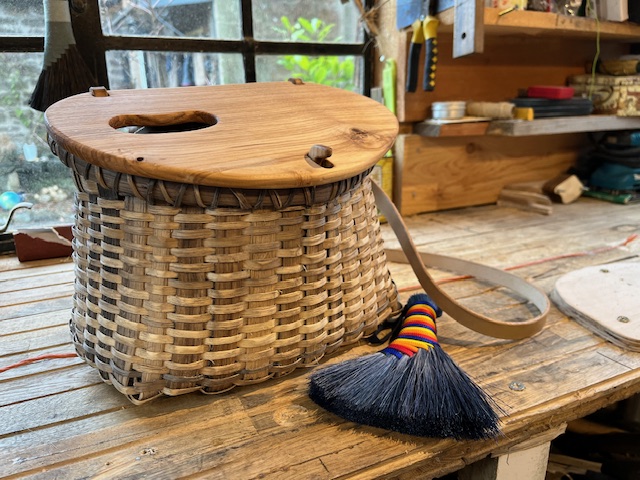
Swill basketry is now listed as a critically endangered craft. Apart from makers such as Owen Jones and Lorna Singleton, very few people regularly make swill baskets, and even fewer are in a position to pass the skills on. Yet historically these baskets were everywhere. They were made across parts of northern Britain and Scotland and used in agriculture, industry and the home.
One of my favourite experiences was taking swill baskets to the Edinburgh Smallholders Festival. Older visitors would often stop and tell me stories of using them when they were young. In Scotland, many people knew them as “tattie baskets” because they were used for lifting potatoes. Their faces would light up with recognition. A few admitted they were glad when wire baskets arrived because they were lighter and didn’t clog up with mud, but there was always real affection for the old baskets.
What strikes me is that these were never luxury objects. They were practical tools made for everyday work. Yet people still remember them seventy years later.
Traditional crafts teach us patience, resourcefulness and respect for materials. They remind us that useful objects can also be beautiful. They also have much to teach us about sustainability. A swill basket begins with a coppiced tree. The carbon remains locked within the basket while the tree regenerates and continues growing. A well-made basket can last for generations.
I once met a woman who had used a swill basket for over seventy years to dry the withers of her Clydesdale horses. When it finally failed, she sent it to Owen Jones for repair. The basket was restored and returned to use. The idea that a handmade object can serve one family for well over a century feels remarkable in today’s disposable world.
Creative Practice
Much of my work begins by looking at historic examples and learning from those who have gone before.
Oak swill basketry is a highly structured craft. There are established forms, proportions and techniques which have evolved through centuries of use. My goal is not necessarily to reinvent these forms, but to become increasingly skilled in making them well.
At the same time, I enjoy exploring related basket traditions and learning from makers around the world. One particularly memorable connection was with an American basket maker called Billy Ray Sims. I had admired a white oak fishing creel he had made and sent him a message asking for advice. What followed was an extraordinary act of generosity. We exchanged emails and video calls, and he eventually sent me materials, leather straps, a lid, and even a former for shaping these baskets.
That experience reinforced something I have found repeatedly within traditional crafts: people genuinely want these skills to survive. The generosity of makers is one of the most rewarding aspects of being involved in these communities.
I sometimes wonder whether working so closely with natural materials and landscapes encourages a particular outlook. Whatever the reason, almost everyone I have met through basketry and traditional crafts has been welcoming, generous and eager to share knowledge.
Sharing
Sharing these skills is becoming an increasingly important part of my practice.
At present I teach hand-bound brush making and am preparing to teach hazel basketry. My ambition is also to teach oak swill basketry, but there are practical challenges. Swill basketry requires specialist tools, access to suitable materials, large boilers for preparing oak, and enough space for students to work safely.
One of the greatest barriers is actually the availability of raw material. Traditional coppice woodlands that once supplied basket makers have largely disappeared. The future of these crafts depends not only on teaching the skills but also on restoring the woodland systems that produced the materials in the first place.
When people encounter these crafts, however, the response is overwhelmingly positive. Many have never seen a swill basket before. Others remember them from childhood. Almost everyone becomes fascinated when they discover that a basket can begin as a standing tree and be transformed entirely by hand.
Hopes for the Future
Looking ahead, I hope to continue developing both my own making and opportunities for others to learn.
One of my long-term ambitions is to establish or manage a coppice specifically for basketry and traditional crafts. The oak planted today may never be harvested in my lifetime, but perhaps someone I teach in the future will use it. There is something rather wonderful about working on that timescale.
Hazel offers a shorter-term opportunity, and I hope to grow and manage hazel for basket making in the years ahead. I am also increasingly interested in learning and teaching birch besom broom making, another critically endangered craft which deserves a future.Traditional crafts survive because people choose to learn them, practise them and pass them on. I see myself as only one small link in that chain.
If I could offer one piece of advice to anyone starting out, it would be simply to have a go. Almost every opportunity I have had in craft began by asking a question, signing up for a course or sending an email to someone whose work I admired. Traditional crafts can seem daunting from the outside, but they are full of generous people willing to share their knowledge. I am certainly glad I took that first step.
Connect with Simon:
Instagram: @the_bumbling_basketeer
Website: Link Here


