Scottish country dance is a social dance tradition enjoyed by thousands of people in Scotland and around the world. Danced in groups of couples arranged in sets, it combines shared movement, live music and intricate formations.
In the 20th century, Scottish country dance became regulated in order to standardise teaching and preserve a shared repertoire. The principal body overseeing this work is the Royal Scottish Country Dance Society (RSCDS), which supports classes, events and teacher training internationally.
Country dancing was popular across Europe from at least the 16th and 17th centuries. In Scotland during the 18th and 19th centuries it was often referred to as “English country dancing”, reflecting the fact that many published collections and teachers were based in England. However, paintings from continental Europe and other historical sources suggest that couple-based country dances have existed in various forms for over 500 years.
In Scotland, dancing masters travelled between towns teaching country dances alongside Highland dances and other fashionable forms. Although they shared repertoire, there were often local variations in steps and formations.
By the early 20th century, some dancers became concerned about inconsistencies in how dances were taught. In 1923, the Scottish Country Dance Society was formed to standardise steps and publish authoritative dance books. The organisation later became the Royal Scottish Country Dance Society. It quickly grew in popularity and continues to publish manuals and collections to ensure consistency of teaching worldwide.
Today, the RSCDS has an international membership of around 11,000 dancers, with branches across Scotland and globally.
How the Dances Work
Scottish country dances are performed in sets, usually two parallel lines of three to five couples facing each other. Within each set, the “top couple” begins the sequence of figures (movements), and each couple in turn leads the dance.
The emphasis is on formations and patterns created by the group rather than on complex individual footwork. While there are recognised steps, the primary focus is on teamwork, timing and spatial awareness.
There are now thousands of dances in the repertoire, ranging from simple social dances to more intricate choreographies performed by experienced dancers.
Music and Performance Style
Scottish country dances are set to marches, jigs, strathspeys and reels. The music is played at a measured pace to support the dancers’ steps and figures.
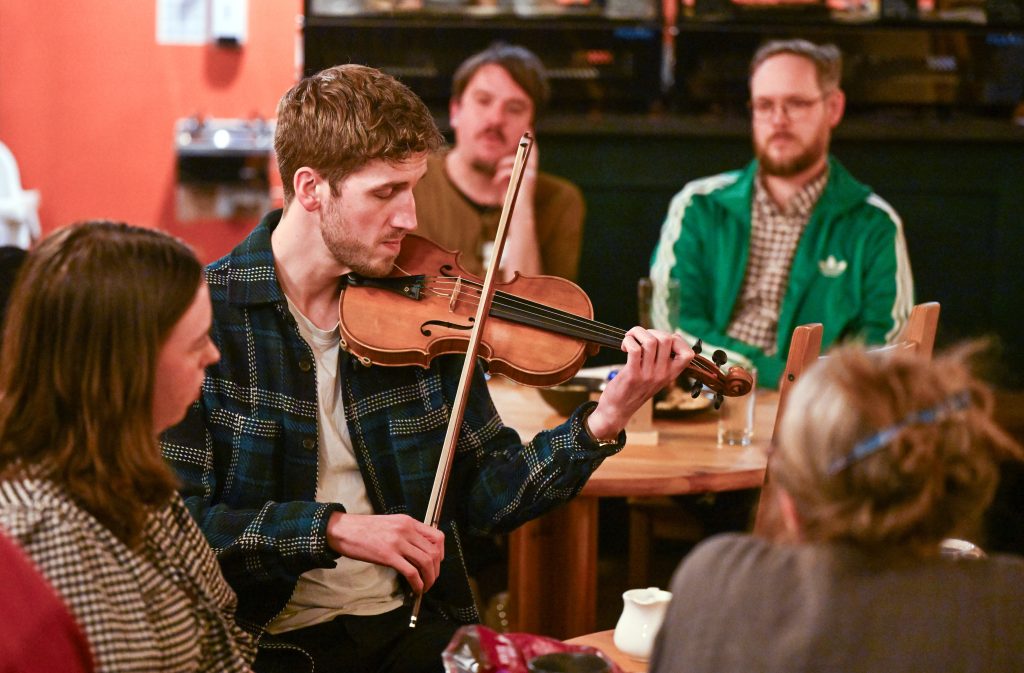
Dances may be accompanied by live bands or by recorded music. A traditional country dance band typically includes accordion (often one or two), fiddle, drums and keyboard. Weekly classes often use a pianist or recorded tracks, while larger events and balls feature full live bands.
The RSCDS also provides training opportunities for musicians, recognising the close relationship between dance and music in the tradition.
Regulation and Examinations
Like Highland dance, Scottish country dance has a regulated structure. The RSCDS oversees graded examinations for children and adults, as well as qualifications for teachers. This framework was designed to ensure that dances are taught and performed consistently across branches worldwide.
Standardisation does not prevent variation in social settings, but it does provide a shared foundation that allows dancers from different countries to dance together with confidence.
Learning and Participation
Scottish country dance is widely accessible. Local RSCDS branches and independent groups hold regular weekly classes, social dances and larger events. The RSCDS runs annual Summer Schools in St Andrews, attracting dancers from around the world for intensive classes, workshops and evening dances.
Because it is a social form, Scottish country dance welcomes a wide range of ages and abilities. While some dancers pursue examinations and teacher training, many participate simply for enjoyment, exercise and community.
The RSCDS website has a list of Scottish country dance groups and branches. It also advertises its international dance and teaching events.
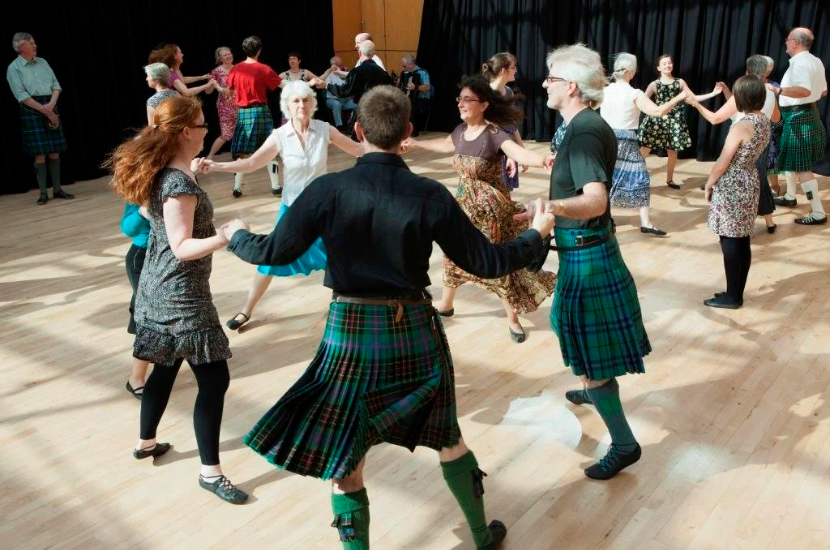
Scottish country dance remains a living and evolving social tradition. While rooted in centuries of shared European dance history, it has developed a distinct Scottish identity through its music, repertoire and organisational structure.
Bringing people together through movement and live music, Scottish country dance continues to play a significant role in Scotland’s cultural life and in the global Scottish diaspora.
More information and lists of Scottish Country dance schools can be found on these websites:
TRACS (Traditional Arts and Culture Scotland, SCIO SC043009) is a co-operative network which champions our shared traditions of music, song, storytelling, dance, crafts, customs and indigenous languages. Together we celebrate the local distinctiveness of Scotland’s places: our intangible cultural heritage. Registered office at the Scottish Storytelling Centre, 43-45 High Street, Edinburgh EH1 1SR.