


After thirty years of telling stories, Ailie Finlay looks back on the people and tales that have stayed with her throughout the years. She talks about the stories that shaped her life and the part audiences play in the art of storytelling, and how, when that connection is harnessed well, the real magic begins.
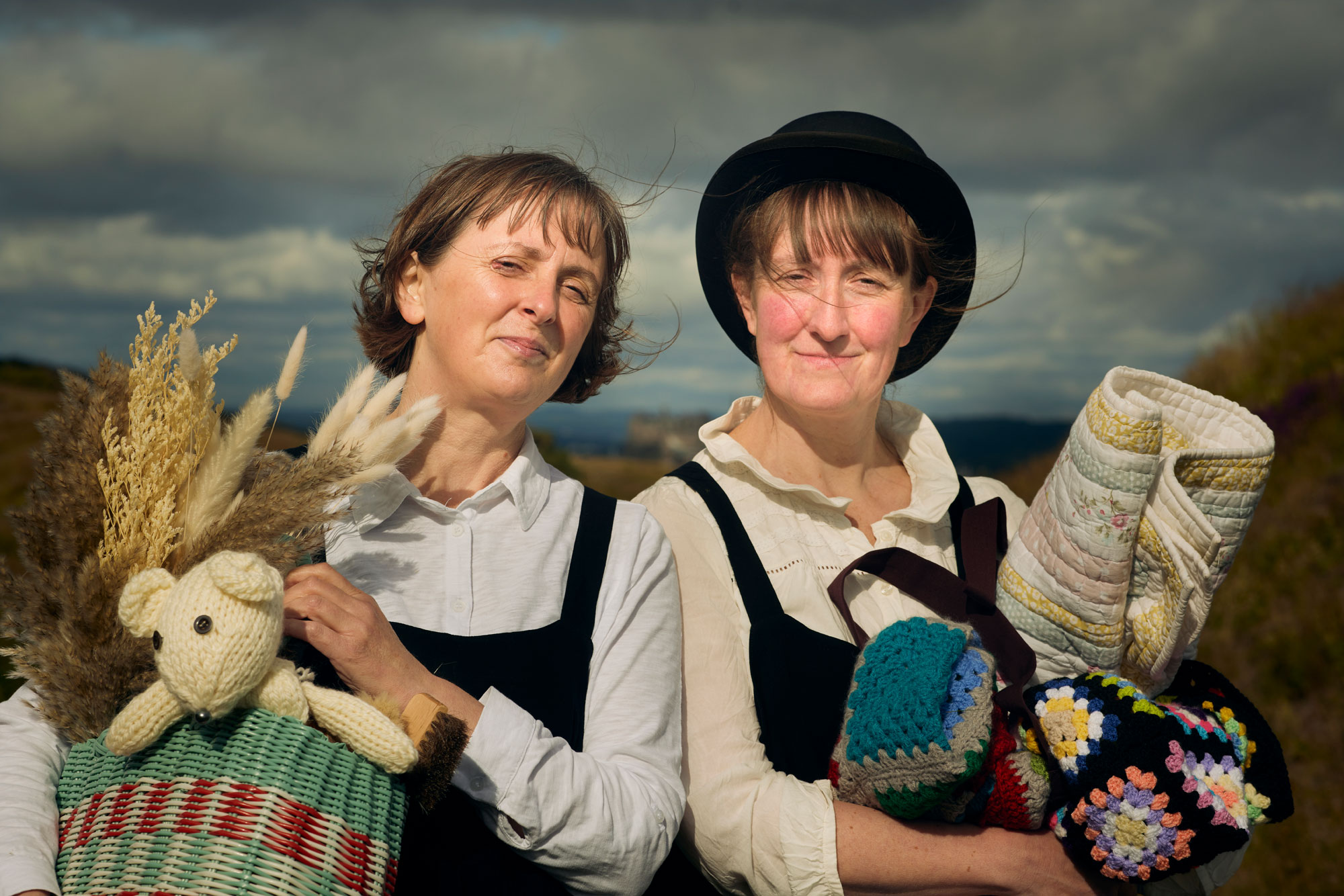 L t R: Ailie Finlay and Kate Leiper
I have been a storyteller for over thirty years. And of course, a story listener. Jackanory laid the groundwork and then the wonderful Janis Mackay taught me the fundamentals of traditional storytelling in my youth. And then there have been all the other tellers I have heard through the years. Mostly what sticks in my mind is not a whole story session or even a whole story but little fragments of story bliss. I remember a teeny-tiny tale told by Jay O’Callahan a quarter of a century ago about a bee that could not fly. My memory is of a very dark autumn night and then this bright piece of exuberance beaming out of Jay from the Netherbow stage. It still makes me smile every time I think of it.
Other fragments in my mind include Ian Stephen’s sea stories, Claire McNicol telling tales at sunset on Inchcolm Island and Mrs Mash (aka Marie Louise Cochrane) telling healthy food stories whilst sharing the stage with a giant banana. And – more recently – Anne Hunter and her tale of the origins of Silent Night in a Christmas story session at the National Library.
Of course, the skill of these storytellers is unquestionable and very important. But thinking about what has stayed with me through the years I can see it is always connection, humour, warmth – and the occasional bit of silliness – that I have valued the most. It is these aspects of traditional storytelling that I am interested in preserving and promoting more than any particular tales or traditions.
Storytelling in Practice
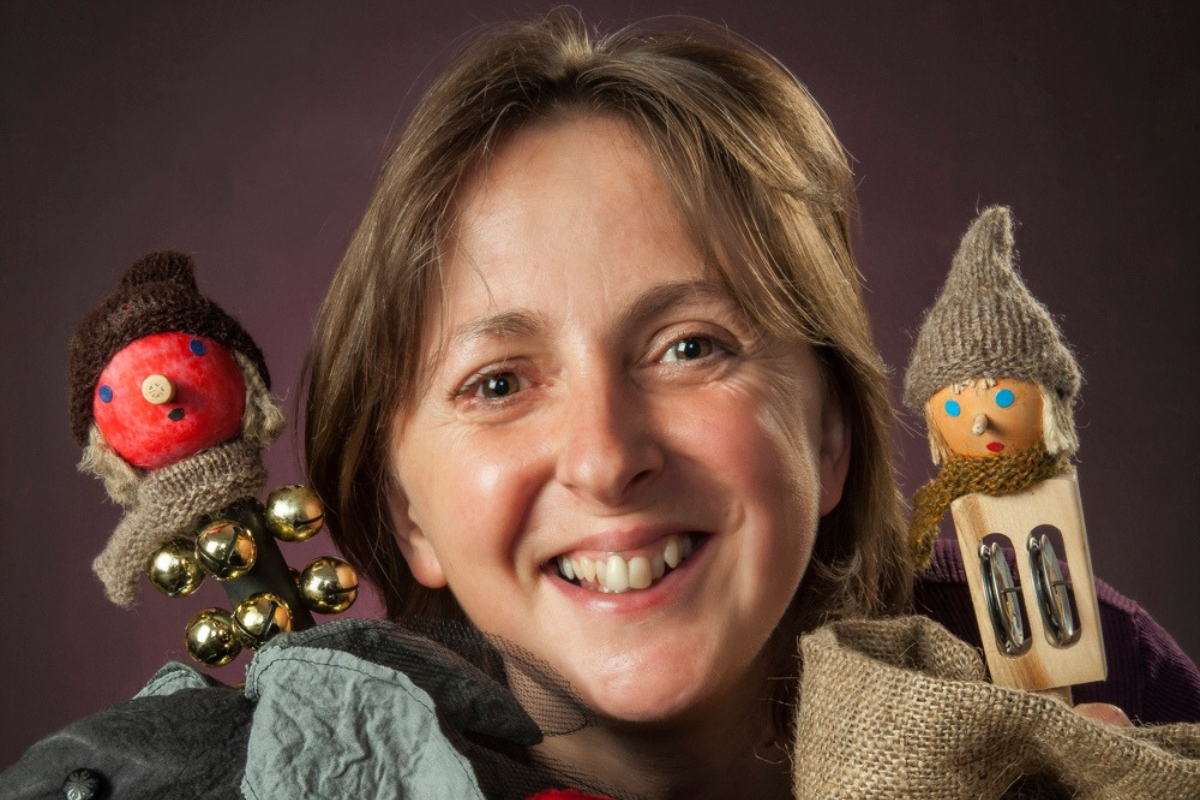
When it came to the development of my own practice, repetition was my best tutor. In my 20s and 30s, I did regular story sessions in schools, and for many years I did puppet and story sessions in nurseries in the run-up to Christmas. I was Santa’s warm-up act! Repeating the same stories over and over to the same age group taught me about pacing and processing time.
For the past fifteen years I have specialised in sharing stories with people with additional needs, in particular those with severe or profound additional needs. A typical story session for me might be in a day services centre for a group of adults with learning disabilities and their support staff or in a classroom in an ASN school. I use props and objects to make my stories more engaging and understandable. I have cupboards full of things that moo and baa or huff and puff. I have musical boxes and bells. I have tactile props that feel like cat’s whiskers, cold ghosts, summer grass or the heat from a stove. I usually work with small groups and the sessions are very interactive with many opportunities for joining in. Almost all my props are designed to be handled by the audience. There are things to squish, shake, throw and drop.
Aims as a Storyteller
My aim, of course, is to allow people to share the joy of our traditional tales. These stories belong to us all and everyone should be able to enjoy them. For some audiences, it can take a little thought and creativity to work out how to tell a story in a way that will work. Can a folktale be told in a tactile way for someone who has a dual sensory impairment? Can a yarn incorporate physical activity for a child with severe learning disabilities who finds it difficult to sit still? Can an owl call whistle, an ocean drum or a whoopee cushion provide such a tempting beginning to a story that it will win over a child who is anxious, ill-at-ease or uninterested? For me the conundrums of creating a story that it truly accessible is part of the point – it is not just a duty but a fun and creative process.
I particularly love to tell (and preserve) our simplest stories – the ones where the bones of the story poke through. I love ‘The Enormous Turnip’, ‘This is the House that Jack Built’, ‘The Flea and the Louse’, ‘The Little Red Hen’. These are our humble tales – not glamorous, large or complex but as complete and satisfying as a slice of fresh-baked bread with butter.
For the audiences I work with, these kinds of stories are vital. Their simple structure gives them a deliciously enjoyable predictability. (That wolf is definitely going to huff and puff more than once!) It is the same feeling in the stomach that you may remember when as a child, you played hide-and-seek and could hear the seeker coming closer and closer. Using simple (but not necessarily childish) stories is the easiest way to make this feeling accessible to people with additional needs.
I love these old tales and work hard to do them justice in my telling. I carefully find a balance between being faithful to the old versions of the tale and adapting it to make it accessible for people who would otherwise not be able to enjoy it. (And I have to confess that I do tend to change endings so that they do not involve too much carnage, death or unlikely matrimonial bliss.)
The magic starts with the audience
I love the stories very much. But sometime around 2012 I had an epiphany. I had been telling stories for a couple of years to children and adults with additional needs when it dawned on me that the people who were booking me (headteachers, day centre managers) were not actually particularly interested in the stories – or indeed in me, the storyteller. What they were interested in was the reactions of their adult service users or learners. Success for them was someone joining in with a refrain, stretching out a hand for a prop, a comment, a laugh. Or sometimes it was even more fleeting – a little bit of eye contact, a flicker of engagement.
This is the most important thing I have learned. The story has to be right, and the storyteller has to be ready to tell – but the magic only comes when we focus absolutely on our audience. This is particularly important for my inclusive storytelling practice, but it applies to all audiences.
Perhaps this is why after thirty years of experience I still feel like a beginner. If storytellers were to collect the equivalent of swimming badges, I think I would be awarding myself a tadpole badge now…definitely not a dolphin. Yes, I have told many of the stories hundreds of times before. And I have quite often met my audience members on numerous occasions. (At this point, I am sometimes telling tales to adults whom I first met as toddlers.) But each time it is a new beginning and I am starting again, hoping that I might be able to create storytelling magic.
Get in Touch
Ailie Finlay | Director at My Kind of Book


